

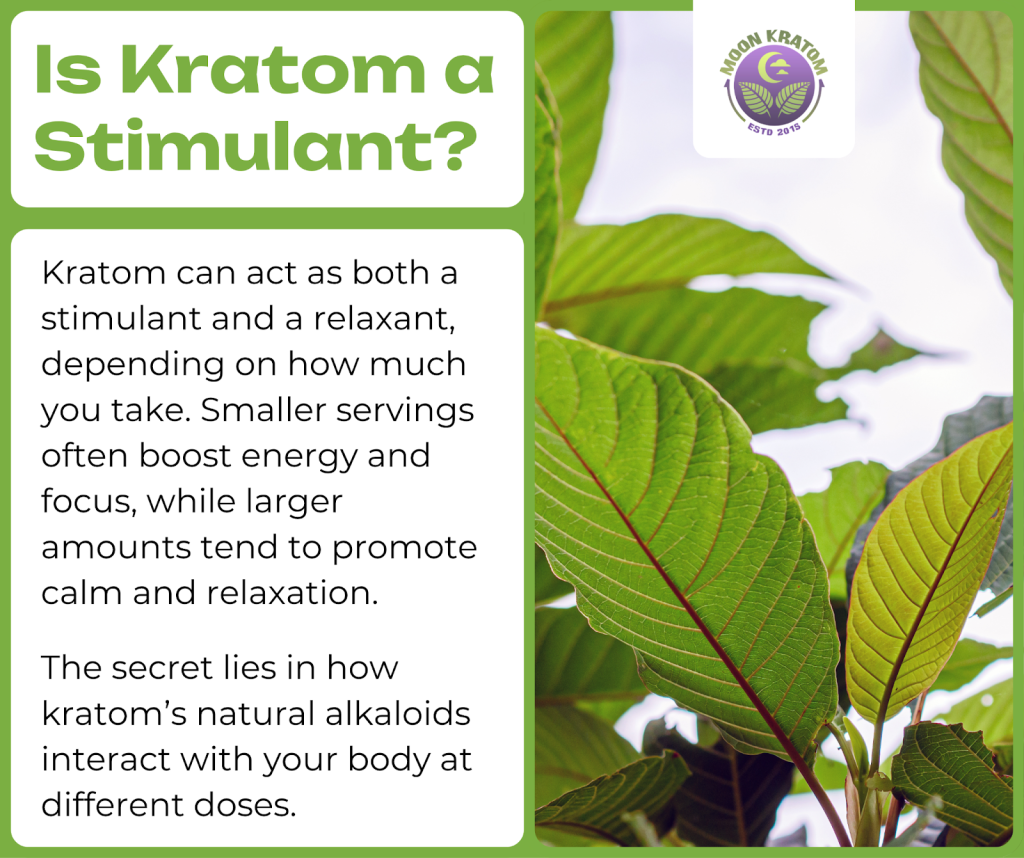
Kratom can act as both a stimulant and a relaxant, depending on how much you take. Smaller servings often boost energy and focus, while larger amounts tend to promote calm and relaxation. The secret lies in how kratom’s natural alkaloids interact with your body at different doses.
Key Points to Know:
- Low doses (1–5 grams) may enhance alertness and motivation
- Moderate doses (5–8 grams) can mix stimulation with relaxation
- High doses (8+ grams) often lead to sedating, soothing effects
If you’ve ever struggled to find kratom that feels consistent, Moon Kratom is here to help. We source small-batch, lab-tested products directly from trusted growers, so you always know exactly what you’re getting.
Keep reading to discover how kratom’s stimulant effects really work, why dosage makes such a big difference, and how to choose the right serving for your goals.
The Science Behind Kratom’s Dual Nature
Kratom’s dual nature comes down to its two main alkaloids, mitragynine and 7-hydroxymitragynine, which interact with multiple receptor systems in the body.
Mitragynine, the dominant alkaloid (about two-thirds of kratom’s active compounds), appears to influence adrenergic and serotonin pathways at lower amounts, which may explain its naturally stimulating, mood-lifting qualities. At higher concentrations, it also engages mu-opioid receptors, contributing to the calmer, more relaxing effects many users report.
7-hydroxymitragynine, though present in much smaller quantities, binds much more strongly to opioid receptors. Even in trace amounts, it may tip the balance toward deeper relaxation and sedation.
How Kratom Compounds Interact With Your Brain
The question “is kratom a stimulant” becomes clearer when you understand how kratom’s alkaloids target different brain receptors based on concentration levels.
Low-Dose Stimulation Through Adrenergic Pathways
At lower servings (around 1 to 5 grams), kratom’s main alkaloid, mitragynine, is believed to influence adrenergic receptors. This interaction may help explain why smaller amounts of kratom can feel energizing, enhancing alertness and focus in a way that some users compare to caffeine:
- Increased alertness and focus
- Enhanced energy levels
- Improved motivation
- Heightened mental clarity
This adrenergic activation explains why many report stimulant-like effects from smaller kratom doses, particularly with white and green vein strains.
Higher Doses Shift to Opioid Receptor Dominance
When servings reach around 8 grams or more, kratom’s alkaloids start to engage mu-opioid receptors more prominently. At this level, the effects often shift from energizing to relaxing, which many users describe as:
- A calm, soothing body sensation rather than stimulation
- A sense of physical ease or comfort
- Enhanced relaxation and mood balance
- Occasional drowsiness
The same kratom that energized you at 2 grams can make you sleepy at 10 grams due to this receptor preference change.
Individual Metabolism Creates Unique Responses
Your personal brain chemistry significantly influences whether kratom acts as a stimulant for you. Key factors include:
- Metabolism Speed: Everyone processes kratom a little differently. Some people notice the effects wear off faster, while others feel them for longer. Tthis often comes down to how quickly your body breaks down the alkaloids.
- Personal Sensitivity: Individual body chemistry plays a big role. Certain users may feel energizing effects from smaller amounts, while others need a bit more to notice the same lift.
- Building Tolerance: With regular use, many people find that kratom’s stimulating effects aren’t as pronounced as they once were, which is why rotating strains or taking short breaks can help maintain balance.
This individual variation explains why the same kratom dose can energize one person while relaxing another, making personal experimentation with small doses essential for understanding your unique response pattern.
Stimulant vs Sedative: The Dosage Connection

The question “is kratom a stimulant” depends entirely on how much you take. Kratom’s effects shift dramatically across different dosage ranges, making it both a stimulant and sedative depending on the amount consumed.
Low-Dose Stimulant Effects (1-5 grams)
At doses between 1-5 grams, kratom produces clear stimulant effects:
- Increased energy and alertness
- Enhanced focus and concentration
- Improved mood and motivation
- Physical stimulation similar to caffeine
- Reduced fatigue and mental fog
Most users seeking energy benefits stay within this 2-4 gram range to avoid unwanted sedation.
The Critical Transition Zone (5-8 grams)
Between 5-8 grams, kratom’s effects become unpredictable. You might experience:
- Mixed stimulant and sedative effects
- Energy followed by drowsiness
- Increased risk of nausea and dizziness
- Inconsistent mood effects
Many users accidentally overshoot their ideal dose in this range, leading to uncomfortable mixed effects.
High-Dose Sedative Effects and Risks (8+ grams)
At doses above 8 grams, kratom becomes predominantly sedating:
- Strong drowsiness and fatigue
- Pain relief but reduced alertness
- Increased risk of nausea and vomiting
- Potential respiratory depression at very high doses
- Higher tolerance development risk
The stimulant question becomes irrelevant at these doses since sedation overwhelms any energizing effects.
Key takeaway: Start with 1-2 grams if seeking stimulant effects, and never exceed 5 grams if energy and focus are your goals. Higher doses will counteract the stimulating properties you’re seeking.
Comparing Kratom to Traditional Stimulants
How does kratom stimulation differ from caffeine?
Kratom and caffeine work through completely different brain pathways, creating distinct stimulating experiences. This difference shows up in how each substance affects your body:
Caffeine stimulation:
- Sharp energy spike followed by crash
- Increased heart rate and jitters
- Mental alertness with potential anxiety
Kratom stimulation:
- Smooth, sustained energy without crashes
- Enhanced focus with mood elevation
- Physical motivation combined with mental clarity
The key difference is kratom’s dual-action mechanism. At stimulating doses, you get clean energy without the jittery side effects common with high caffeine intake.
How long do kratom’s stimulating effects last compared to other stimulants?
Duration varies significantly between kratom and traditional stimulants:
- Caffeine: 3-5 hours with noticeable crash
- Kratom (white/green strains): 4-6 hours with gradual tapering
- Energy drinks: 2-4 hours with harsh comedown
- Prescription stimulants: 4-12 hours depending on formulation
Find Balance with Quality Kratom

Kratom’s effects can shift from stimulation to relaxation, but one thing should always stay consistent: quality. At Moon Kratom, we’ve spent over a decade perfecting the balance between freshness, transparency, and reliability. Every batch is lab-tested, clearly labeled, and sourced from trusted farms, so you can explore kratom’s energizing or calming side with confidence.
Shop Moon Kratom today and find the perfect strain to match your energy, focus, or relaxation goals.
Disclaimer: These statements have not been evaluated by the FDA. Kratom is not intended to diagnose, treat, cure, or prevent any disease. This product is not for use by minors, pregnant or nursing women. Consult your healthcare provider before use if you have medical conditions or take medications.
You must be logged in to post a comment.